
01 – Background of Energy Storage Fire Protection System Development
With the global energy structure transformation and the large-scale replacement of renewable energy, the application of energy storage systems in the energy field is increasingly attracting attention. However, safety issues of energy storage systems have always been one of the bottlenecks restricting their development. Fire protection, as the last passive defense system, its reasonable design, material selection, layout, and construction directly affect the healthy development of the energy storage industry.
02 – Classification of Fire Hazards
Fire hazards in lithium battery energy storage systems are generally divided into electrical fires and battery fires.

Electrical Fires
Electrical fires mainly originate from the large number of electrical devices in lithium battery energy storage systems, including PCS, transformers, DC circuits, power distribution systems, etc. The high voltage and current in the system will inevitably have a significant impact on the energy storage system and can also cause damage to protective components of the energy storage system, leading to failure to act or even causing a fire.
Battery Fires
Battery fires mainly stem from the internal composition and structure of the batteries. Due to quality control issues or improper operations during battery manufacturing, transportation, installation, and use, the risk of thermal runaway increases significantly. Thermal runaway refers to the uncontrollable phenomenon of rapid temperature rise in the battery caused by internal self-heating chain reactions. When the heat generated by thermal runaway exceeds the heat dissipated by the battery’s external environment, it can lead to overheating, gas release, and even fires or explosions. Moreover, the battery modules in lithium battery energy storage systems are designed to connect multiple battery packs in series, which undoubtedly increases the safety hazards of lithium batteries.
03 – Fire Prevention, Alarm, and Extinguishing Control Strategies
Since battery preheating compartments are electrical equipment, fires occur after the energy storage batteries burn inside the compartment. At present, the fire rescue strategy adopted is “cut off power first, then extinguish,” therefore, when arranging the battery prefabricated compartments, not only should the maximum avoidance of fire spread between compartments be considered, but also sufficient fire protection space should be reserved.
The fire control components automatically activate the fire extinguishing system upon receiving warning signals or fire signals, and shut down operating electrical equipment according to the established extinguishing strategy.
When patrol personnel discover a fire but the fire extinguishing system has not automatically activated, personnel should manually activate the fire extinguishing equipment.
When the compartment circuit breaker refuses to trip, maintenance personnel should manually monitor the video to determine the fire. Through the BMS system, send a circuit breaker trip signal to the control host to activate the corresponding bottle group valve and select valve for remote activation of fire extinguishing. The fire extinguishing strategy of the fire protection system is shown in the figure below.
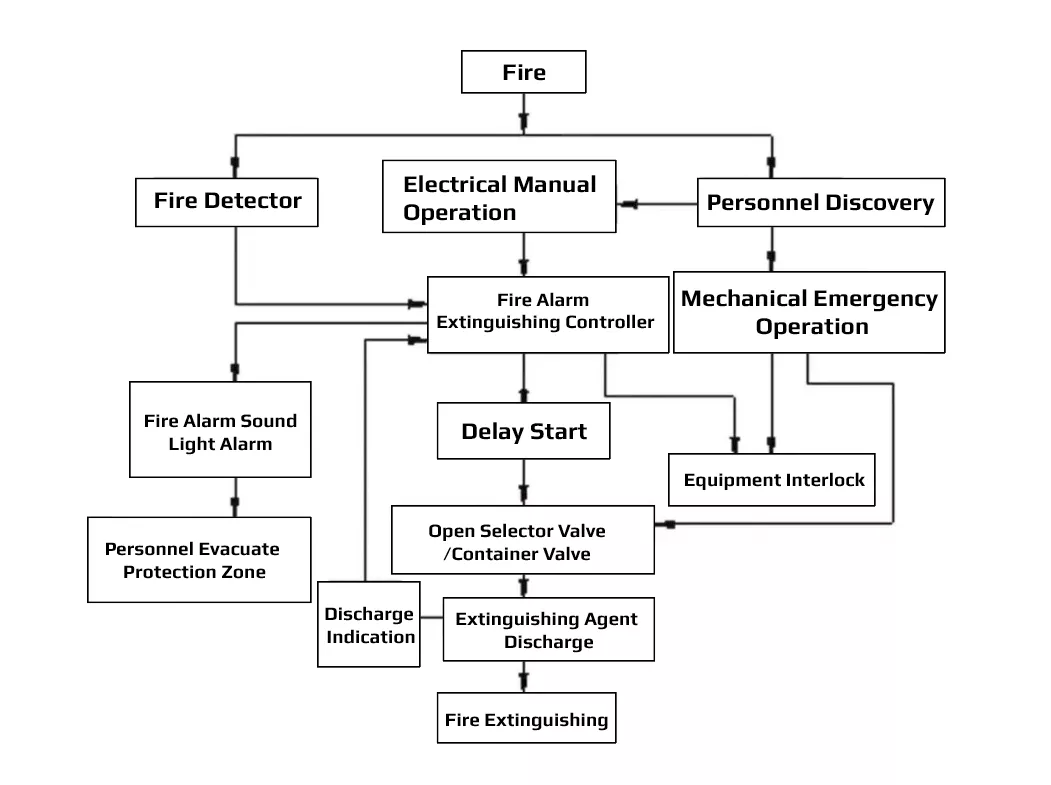
04 – Fire Prevention, Alarm, and Extinguishing Control Strategies
Total Flooding Extinguishing
Total flooding extinguishing systems refer to the fire extinguishing systems that, within a specified time, spray a certain concentration of dry powder into the protection area and cause it to even fill the entire protection area. Generally, energy storage container fire protection systems will choose heptafluorotane extinguishing systems. Experiments have shown that under sealed conditions, heptafluorotane can quickly extinguish fires in lithium batteries and will not reignite in a sealed environment. In addition, ultrafine dry powder and full fluorocarbon can also quickly extinguish fires.
Knowledge Expansion: Heptafluorotane is a colorless, odorless, non-conductive gas, whose extinguishing principle is the inhibition of the chemical reaction chain, stored and released in liquid form. After spraying, the ventilation system can be used to expel the gas from the room. After extinguishing, no residue is left, and it will not cause any damage or pollution to the electrical equipment on site.
Gas Extinguishing System + Sprinkler
The energy storage container fire protection system is designed with a gas extinguishing system and also equipped with sprinklers. This scheme is considered comprehensive, and under scientifically designed circumstances, it is also the most economical. It can suppress initial fires and buy valuable time for subsequent personnel handling. If the fire is large and the sprinklers are also activated, with sufficient water resources, it can completely suppress the fire. If water resources are not sufficient, it can also buy more valuable time for personnel to handle.

PACK Level Extinguishing
PACK level protection refers to the fire protection scheme that protects the battery module unit. Energy storage container PACK level extinguishing, through composite detectors, pipe electromagnetic valves, fire extinguishing devices, etc., detects and sprays to protect each battery pack core value point. The core value is to effectively monitor and extinguish at the initial stage of electrical fires. This scheme usually includes installing combustible gas detectors and extinguishing medium spray heads in each battery module, combined with the battery management system (BMS) to identify the early thermal runaway state of the battery, and quickly extinguish after a single battery thermal runaway through the configured fire extinguishing device, preventing fire spread.
05 – Conclusion
With the continuous improvement of lithium battery technology, its corresponding energy storage systems will also be widely applied. How to ensure the safety of lithium battery energy storage systems is the primary factor affecting development. The energy storage system adopts multi-level active fire protection strategies, built-in multi-in-one fire detection and alarm devices, achieving accurate positioning, precise extinguishing, rapid response, and sustained suppression, further enhancing the safety of system operation.


