
Household Energy Storage
- What is a Household Energy Storage System?
A household energy storage system refers to an energy storage system used in residential scenarios, typically installed in combination with a household photovoltaic (PV) system to provide electricity for the household.
2. Why Do Consumers Opt for Energy Storage?
Saving on electricity bills is a significant motivation for consumers to opt for energy storage. The peak electricity consumption for households occurs at night, while PV generation happens during the day. The mismatch between generation and consumption times means that energy storage can help users store excess daytime electricity for nighttime use. Additionally, electricity prices vary throughout the day, with peak and valley prices. An energy storage system can charge during valley periods via the grid or PV panels and discharge during peak periods to supply loads, thus avoiding high electricity consumption during peak times and effectively saving on electricity bills.
Household Grid-connected Systems
What is a Household Grid-connected System?
Generally, household grid-connected systems can be divided into two modes: full net metering and self-consumption with surplus feeding into the grid.
- Full Metering Mode involves feeding all PV-generated electricity into the grid and earning income based on the amount fed into the grid.
- Self-consumption with Surplus Feed-in Mode involves PV electricity being used preferentially to supply loads, with excess electricity fed into the grid to earn income.
Household Grid-connected Systems Suitable for Conversion to Energy Storage Systems
If a household grid-connected system uses the full metering mode, it is difficult to convert to an energy storage system because:
- The full metering mode has a fixed electricity selling price, providing stable income, eliminating the need for conversion.
- In the full metering mode, the PV inverter output is directly connected to the grid without passing through household loads. Even after installing energy storage, without changing the AC wiring, PV-generated electricity can only be stored and fed back into the grid at other times, not realizing self-consumption.
Integrated Household PV + Energy Storage System
Currently, the conversion of household grid-connected systems to energy storage systems mainly refers to PV systems in self-consumption with surplus feeding into the grid. The converted system can become an integrated household PV + energy storage system. The driving force for the conversion is mainly due to grid companies reducing subsidies for electricity sold or not allowing electricity sales, prompting users with installed household PV systems to consider adding energy storage systems to reduce daytime electricity sales and also decrease nighttime electricity purchases.
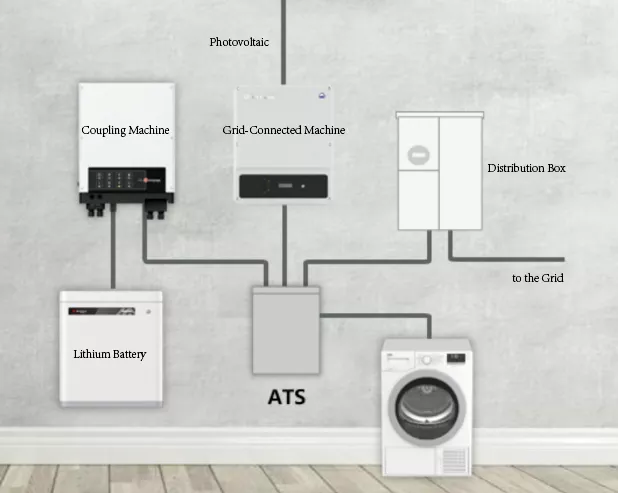
- System Introduction
The integrated PV + energy storage system, also known as the AC retrofit PV + energy storage system, typically consists of PV modules, grid-connected inverters, lithium batteries, AC coupling energy storage inverters, smart meters, CTs, the grid, grid-connected loads, and off-grid loads. This system can convert PV-generated electricity into AC through the grid-connected inverter and then use the AC coupling energy storage inverter to convert excess electricity into DC and store it in the battery.
- Working Logic
During the day, PV generation first supplies the load, then charges the battery, and any surplus can be fed into the grid; at night, the battery supplies the load, with any shortfall supplemented by the grid; during power outages, the lithium battery only supplies off-grid loads, and grid-connected loads cannot be used. Additionally, the system supports users setting their own charging and discharging times to meet their electricity needs.
- System Features
- Can convert existing grid-connected PV systems into energy storage systems at a low cost.
- Provides users with safe power assurance during power outages.
- Compatible with grid-connected PV systems from different manufacturers.
Summary
Although it is currently difficult to convert full metering household PV systems into energy storage systems in China through the methods introduced in this article, energy storage can also be achieved through local storage configurations.


