
A complete electrochemical energy storage system mainly consists of: battery packs, Battery Management System (BMS), Energy Management System (EMS), Power Conversion System (PCS), and other electrical equipment. It is evident that batteries account for about 60% of the entire energy storage system’s cost, while PCS, BMS, and EMS (referred to as “3S”) account for about 35%, playing a crucial role in the energy storage system.

The terms PCS, BMS, and EMS (referred to as “3S”) can also confuse those who are not familiar with energy storage. Actually, understanding what “3S” is, you basically have a good grasp of the energy storage system. Let’s start with BMS to understand the “3S” in the energy storage system.
Basic Concepts
The Battery Management System (BMS) is the brain of the battery energy storage system, acting as the link between battery cells and the energy storage system/energy storage power station, primarily for intelligent management and maintenance of each battery unit to prevent overcharging and over-discharging, avoid thermal runaway, and ensure system safety.
The energy storage BMS system is mainly responsible for battery system status monitoring (measurement of battery parameters, including basic parameters such as voltage, current, temperature, etc., status, as well as the calculation of battery status data such as SOC, SOH), status analysis, and battery charging and discharging management, fault protection, ensuring the system operates safely and efficiently. It can also upload key data to the upper-level system for backup and data analysis.
Composition of BMS
The energy storage BMS mainly consists of two parts: hardware and software. The hardware part includes components such as battery management units, data acquisition units, control units, etc., with the battery management unit being the core component of BMS. The software part includes BMS control programs and data processing programs, which can achieve real-time monitoring of battery status and data processing.

Types of BMS Technology
The types of BMS technology can be divided into several different types based on its structure, function, and degree of integration. Each type has its specific advantages and application scenarios. Choosing the appropriate BMS technology depends on the scale, complexity, cost requirements, and specific application needs of the battery system. Here are several common BMS technology types:
Distributed BMS
Each battery cell or module has its own monitoring and control unit. These units are responsible for collecting data from individual battery cells and performing local balancing and management.
Advantages: High precision and flexibility
Disadvantages: Higher cost and complexity
Modular BMS
Divides the battery pack into multiple modules, each with its own monitoring and control unit, but modules can exchange data through a communication network.
Advantages: High precision and flexibility
Disadvantages: Higher cost and complexity
Centralized BMS
Usually includes a central control unit responsible for the management and monitoring of the entire battery pack. All data from individual cells are sent to the central control unit.
Advantages: Lower cost, relatively simple system
Disadvantages: Inferior precision and response speed
Integrated BMS
Usually closely integrated with the battery pack design, integrating BMS functions into the battery cell design.
Advantages: High integration and compact design
Disadvantages: Some flexibility and upgradability are sacrificed
Three-level Architecture of BMS
In energy storage power stations, the Battery Management System (BMS) typically adopts three-level architecture, with control levels divided into control, master control, and overall control. This architecture is designed to achieve hierarchical management from cells to PACKs to battery clusters and then to container batteries.
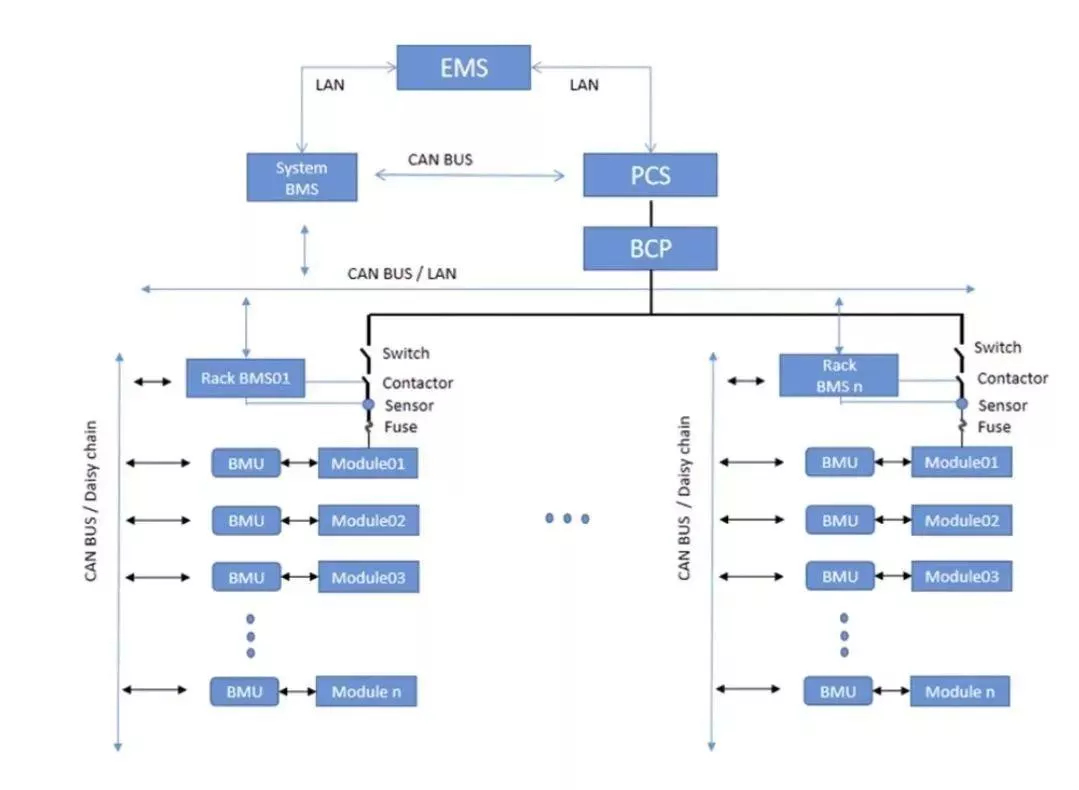
BANK BMS Overall Control Responsible for the management of the entire container battery system PACK BMS Master Control Responsible for the management of a single cluster battery system MODULE BMS Cluster Control Responsible for the management of a single battery PACK
The three-level architecture combines system hierarchical management, ultra-high-capacity management, high-voltage platform management, high-resolution thermal management, full-time balancing management, operation permission management, accurate SOC estimation, efficient loop flow control, and rich external interfaces, which are widely used in energy storage systems.
Market Analysis
The energy situation under China’s “dual carbon” background has promoted new energy power generation + centralized energy storage, and distributed energy storage + charging piles have a huge demand for energy storage systems, thus promoting the rapid growth of the energy storage BMS market. Currently, BMS suppliers in the energy storage market include battery manufacturers, new energy vehicle BMS manufacturers, PCS manufacturers, as well as professional integrators, and companies specializing in the development of energy storage BMS.
It is expected that the installed capacity of energy storage systems in China will maintain a stable growth trend in the future, and the lithium battery energy storage and household energy storage markets are expected to have an annual compound growth rate of about 50% over the next five years. Driven by this trend, it is expected that over the next five years, the energy storage BMS market will expand rapidly at an annual compound growth rate of about 50%, and reach a scale of tens of billions of yuan by 2027*.


